

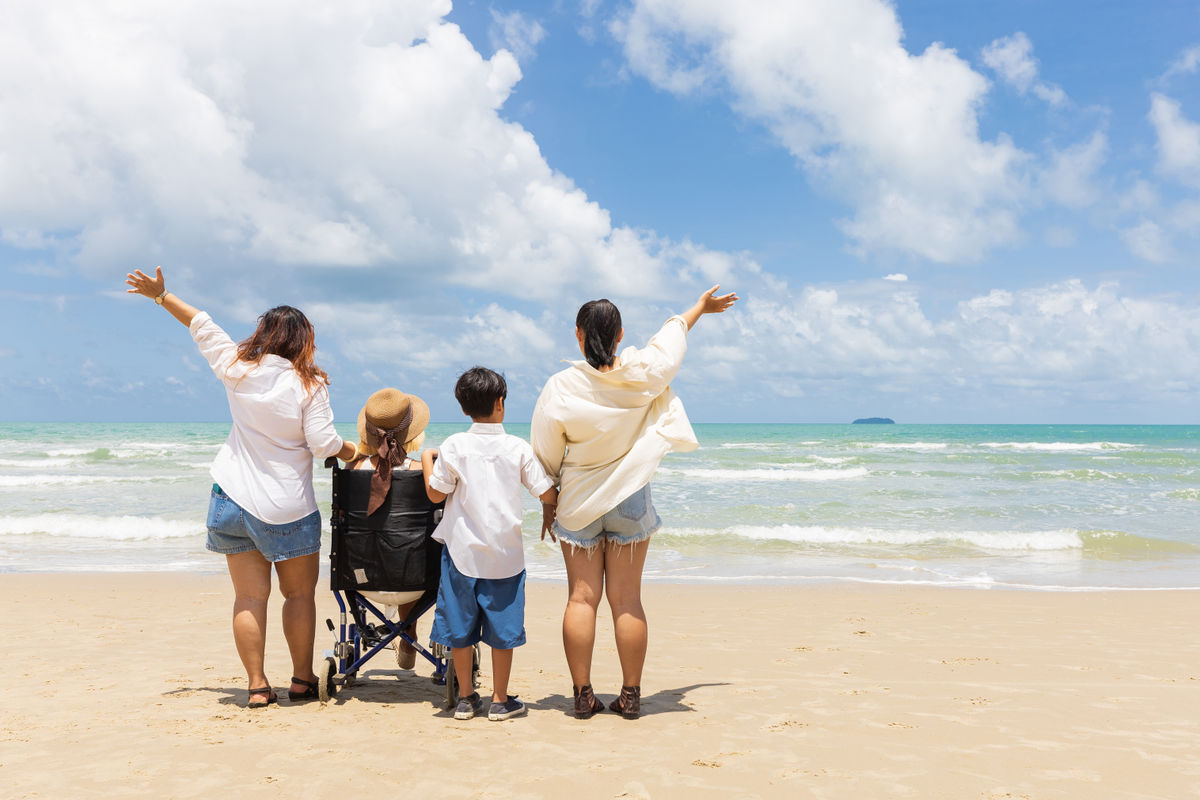

Worldwide, an estimated 1.3 billion individuals—or 1 in 6 people—live with a significant disability. That’s about 16 percent of the global population, according to the World Health Organization. And it’s a very substantial market of potential travel customers.
Just how valuable is this market?
In the past two years, the majority of adults with disabilities (63 percent) have taken at least one trip, and about one-third have taken three or more trips, according to the 2024 Open Doors report, which measures how often adults with disabilities travel. Moreover, these individuals spent almost $50 billion across 76.9 million trips.
The same report indicates that travelers with disabilities are busy exploring a long list of domestic destinations (Atlanta chief among them). Many are also venturing beyond U.S. borders to visit Mexico, Europe and the Caribbean.
This data is impressive, especially given the reality that individuals with disabilities continue to face numerous challenges when traveling.
Air travel is perhaps one of the most notoriously difficult parts of any journey, with a 2022 report from the U.S. Government Accountability Office pointing out that travelers with disabilities continue to face a “range of barriers to accessible air travel” at every step of the process, from passenger screening to onboard planes. That includes difficulties obtaining a wheelchair or customer assistance, to obstacles accessing onboard lavatories.
A separate report published from MMGY titled “Portrait of Travelers with Disabilities: Mobility and Accessibility,” further underscores this fraught reality, explaining that the “challenges for this group are very real and are found at every step of the travel-planning process and journey.” Some of the key takeaways from the MMGY findings included:
Four in 10 travelers with disabilities have had their mobility aid lost or damaged by an airline.Six in 10 have experienced extended wait times for mobility assistance at the airport before or after their flight.More than half (54 percent) have been given a room at check-in that did not match the room they booked.81 percent have dealt with inaccessible showers or tubs, and 52 percent have encountered beds that were too high for them to access.
While the travel industry has a long way to go to be genuinely
accessible to all, the good news is that a growing number of
destinations, brands and tour operators stand out for their efforts thus
far to bridge the gap and break down barriers.
Here are some of
the destinations, tour operators, transportation companies and more that
are helping to make travel far more accessible for individuals with
disabilities.
Destinations
Ann Arbor, Michigan
Destination
Ann Arbor’s approach to accessibility is grounded in a clear mission:
make inclusive travel a core part of the visitor experience, not an
afterthought.
To help Ann Arbor achieve that goal, the destination
regularly convenes an Accessibility Roundtable made up of disability
advocates, the local Disability Network, nonprofits, and community
leaders “who meet to guide long-term accessibility strategy and shared
priorities,” says Chad Wiebesick, director of media relations and
special projects for Destination Ann Arbor.
“This collaborative
structure ensures accessibility efforts are not a one-time initiative,
but a sustained commitment shaped by the lived experiences of people
with disabilities,” Wiebesick tells TravelPulse.
So what does that mean in practice for visitors with disabilities?
In
partnership with Wheel the World and the local Disability Network, more
than 50 hotels, attractions, restaurants, and cultural venues across
the Ann Arbor area have completed in-depth accessibility assessments
capturing over 200 data points per location.
Those assessments went
far beyond basic ADA checklists to document the real-world details
travelers with disabilities need to plan confidently, including entrance
routes, restroom layouts, elevator dimensions, seating configurations,
and more.
All of this verified information is now publicly available
on the Wheel the World website, a travel booking platform for
individuals with disabilities that allows travelers to find, compare,
and book travel experiences tailored to their accessibility needs.
As
for Ann Arbor, the community’s efforts culminated in the city becoming
Michigan’s first Wheel the World Destination Verified community. Having
earned such a designation is an important step, underscoring Ann Arbor’s
care and commitment to travelers with disabilities.
Ann Arbor’s
community-centered approach has also earned the city national
recognition. And perhaps even more importantly, the community, says
Wiebesick, is now serving as a model for other destinations that are
working to better support accessible travel.
Jacksonville, Florida
With 22 miles of beaches and year-round sunshine, the city
of Jacksonville, Florida is a perennial favorite among travelers. And the good news is, the destination’s leaders are busy working to ensure that Jacksonville’s offerings are accessible to
all travelers.
In 2023, for instance, Visit Jacksonville, the
city’s destination management organization (DMO), became Florida’s first
autism-certified DMO. The designation, awarded by the International
Board of Credentialing and Continuing Education Standards (IBCCES),
means that the Visit Jacksonville staff has undergone specialized
training to better understand and meet the needs of autistic visitors
and their families.
That
designation is particularly meaningful in light of an IBCCES survey of
parents, families, and autistic individuals, which found that 94 percent
of these respondents would take more vacations or visit more new places
if they had access to autism-trained and certified options.
In Jacksonville there are several attractions
designed to be accessible for individuals with autism. That includes the
city’s Museum of Contemporary Art, which offers Autism Creates (an
educational initiative for children with autism spectrum disorders). The
museum also provides an American Sign Language interpreter upon
request.
To provide still more assistance to travelers with autism, Visit Jacksonville’s website includes a page that lists other austism-friendly offerings and attractions in the area.
Vacation rentals
Finding
accessible accommodations when traveling can be another significant
challenge. But it’s one that the luxury vacation villa rental company
Rental Escapes has worked to address.
The
company, which has more than 5,000 destinations in its global
portfolio, offers a curated collection of accessible and
wheelchair-friendly luxury villas designed to support travelers with
limited mobility without sacrificing comfort or experience.
That
includes villas spanning the Caribbean, Mexico, Europe, and the United
States, offering features such as single-level layouts, step-free
entrances, wide doorways, elevators, ground-floor bathrooms and
bedrooms, and roll-in showers.
Accessibility with Rental Escapes
properties goes beyond the physical space, as well. For instance, each
booking is guided by a dedicated villa specialist who personally
confirms the available accessibility features at each property to ensure
guests’ specific needs are met. In addition, select villas offer
dedicated on-site staff who provide comfort and personalized support
throughout the stay.
If additional assistance is needed, Rental
Escapes can provide it through a concierge team that curates every
detail, from bespoke private excursions to chef-led in-villa dining.
Tours and transportation
Custom Tours of DC
If
Washington, DC, is on your to-do list as a disabled traveler, Custom
Tours of DC is here to ensure you have a smooth, memorable experience.
“Custom
Tours of DC specializes in fully private, customized tours designed
around each client’s specific accessibility needs and mobility
considerations,” says Adam Plescia, the company’s founder and owner.
Unlike
standard group tours with fixed itineraries, the company creates
flexible experiences that can be adjusted in real-time based on a
traveler’s energy levels, physical capabilities, and comfort, Plescia
tells TravelPulse.
“Each tour includes a private, climate-controlled
vehicle that serves as a personal rest space throughout the day, stocked
with water and accommodations for medical devices or mobility aids,”
Plescia explains.
In addition, the company’s guides are trained to
design routes that prioritize ADA-accessible venues, well-maintained
pathways, and rest opportunities while avoiding challenging terrain.
This
type of one-on-one attention means guides can move at each client’s
pace, incorporate frequent breaks, and modify plans as needed—whether
that means shortening a walking segment, adding a seated museum
experience, or adjusting timing for medication schedules.
“Because
every tour is built from scratch around the individual traveler rather
than forcing them into a pre-set experience, Custom Tours of DC ensures
that visitors with disabilities can experience Washington D.C.’s
world-class museums, monuments, and cultural sites with dignity, safety,
and genuine enjoyment,” says Plescia.

Daytrip, a global private car transfer service, can make travel for individuals with disabilities far easier. (Photo Credit: Courtesy Daytrip / Tanya Shami)
Daytrip
If you’re an avid
globetrotter and you haven’t already heard of Daytrip, now is the time
to bookmark this company’s website. The global private car transfer
service is one of the best-kept secrets in the travel industry.
Daytrip
makes transportation in destinations around the world practically
effortless. Using the Daytrip website, travelers can book customizable,
private door-to-door car transfers or day trips with English-speaking
drivers.
I’ve personally used this company in Italy and Japan, and it
made my travels a breeze when I needed transportation between cities.
Their drivers are reliable, professional, and friendly, and they
consistently show up on time. They also consistently go above and beyond
to ensure my comfort.
I also love the fact that when booking car
transportation with Daytrip, I have the option to add a sightseeing stop
as part of my transfer between two locations. For travelers with
disabilities, this means being able to explore locations and sights that
may be harder to access using local public transportation.
Some of the specific services Daytrip offers include:
Day
trips: As the company’s name indicates, you can use Daytrip to book a
car and driver who will take you to explore a specific point of interest
in the country you’re visiting. This service can be used in a variety
of scenarios, including when you’re traveling by cruise and want to
explore a destination during a port visit.
Daytrip
transportation also comes in handy when you’re staying in a city and
want to explore beyond city boundaries, where there may be little to no
public transportation (Think: exploring smaller towns, castles, or
nearby attractions).
Transfers (one-way, return, and
multi-city): Yet another helpful service offered by Daytrip is private
transfer between two points with the option to add one or more
sightseeing stops along the way. Travelers often use Daytrip for airport
pick-ups and drop-offs as well.
Past travelers with
disabilities have written glowing reviews about Daytrip, including one
family who said:
“We had two amazing experiences during our trip to
Spain and Portugal with Daytrip. Walter drove us from Lisbon to Lagos
and Nataliya drove us from Lagos to Seville. Both drivers were
professional and kind. They both gave us some history and knowledge of
the places we were arriving to. They accommodated our daughter who is in
a wheelchair. I would highly recommend Daytrip as a transfer service.”
Claire & George
One
final, but especially notable, company is the Europe-based nonprofit
organization Claire & George, which offers accessible holidays in
Switzerland.
And for Florida resident Chelsea Bear, who was born
with cerebral palsy (CP), the organization turned a trip to Switzerland
into a deeply memorable experience that Bear told TravelPulse she will
remember forever.
“Traveling
with cerebral palsy, I’m always thinking 10 steps ahead: ‘Will I be
able to get around? Will it be accessible? Will people actually
understand what I need?’,” says Bear. “I love seeing new places, but it
can also feel like I’m signing up for the unexpected.”
Bear’s 2024 trip to Switzerland with Claire & George, however, changed everything.
It wasn’t the scenery or the food or the people she met that made the trip special (although all of those things were indeed memorable), says Bear. But the game changer was how supported and
included Bear says she felt throughout the entire trip, thanks to Claire
& George.
Managing Director Susanne Gäumann was on the journey
the entire time and ensured that Bear could take part in everything, rather than just watching from the sidelines. “And she did it in a way that didn’t
make me feel like ‘the disabled traveler’ I just felt like a traveler,”
adds Bear.
What’s more, each day of the trip was packed with moments that Bear says she still thinks about two years later.
“In
St. Gallen, I explored the Old Town, wandered through the gorgeous St.
Gallen Cathedral, and tried St. Galler Bratwurst,” continues Bear. “I
also got to tour the Appenzeller cheese factory, which made me
appreciate Swiss cheese on a whole new level. We rode a cable car to the
summit of Säntis Mountain. The views up there honestly didn’t feel
real.”
These are just some of the experiences Bear had while
traveling with Claire & George. The organization has more than a
decade of experience planning holidays for individuals affected by
physical or sensory disabilities. Their services include private tours
and connecting travelers with accessible, wheelchair-friendly hotels.
For
Bear, this type of support was especially meaningful. “Accessibility
was never an afterthought on this trip; it was a part of every plan,
city, and activity,” she says. “Because of that, I got to actually
experience Switzerland, not just ‘see’ it.”
For the latest travel news, updates and deals, subscribe to the daily TravelPulse newsletter.
