

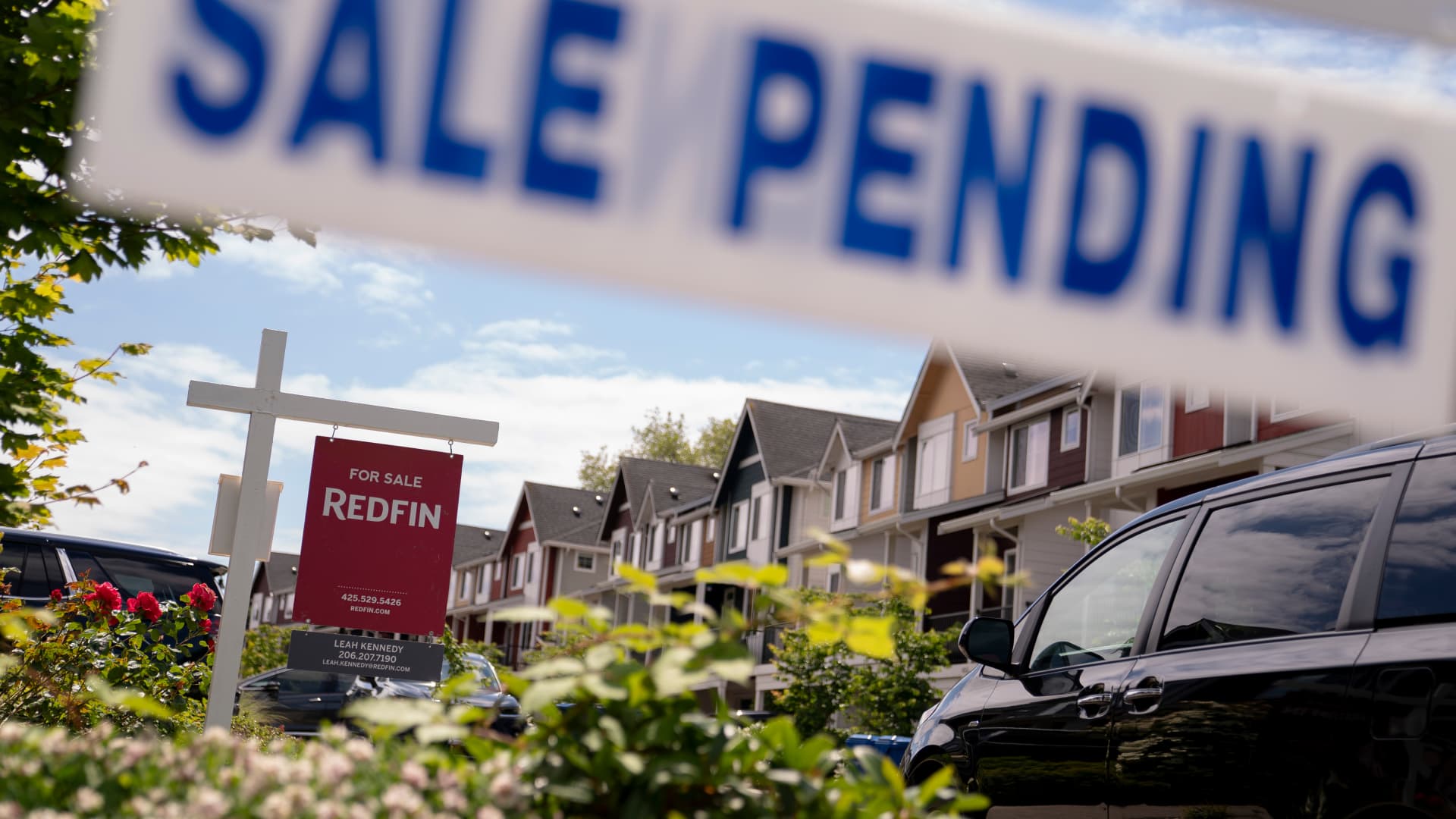
A “sale pending” sign in front of a home for sale in Larkspur, California, Nov. 30, 2023.
Justin Sullivan | Getty Images
Serious headwinds in the housing market and the broader economy are tanking home sales at an alarming rate.
More than 40,000 signed home purchase agreements were canceled in December, representing 16.3% of all homes that went under contract, according to Redfin, a real estate brokerage. That’s up from 14.9% in December 2024.
It’s is also the highest share since Redfin began tracking the metric in 2017.
“High housing costs and rising inventory have made homebuyers more selective,” said Chen Zhao, head of economics research at Redfin. “Home sellers outnumber buyers by a record margin, meaning the buyers who are in the market have options and may walk away if they believe they can find a better or more affordable home.”
There were roughly 47% more home sellers than buyers in the market in December — or 631,535 more — according to a separate Redfin report. That is the largest gap in records dating back to 2013 and up 7.1 percentage points from the previous month.
“I call 2025 the year of the seller, because I had so many sellers reach out,” said Ashley Rummage, a real estate agent from Raleigh, North Carolina, who participated in the most recent CNBC Housing Market Survey. “They were reaching out because they had a lot of fear around the economy. They had a lot of uncertainty around the current administration, mortgage rates, affordability. These are all challenges this year.”
Regionally, Atlanta saw the highest percentage of contract cancellations in December at 22.5%. That was followed by Jacksonville, Florida, at 20.6%; San Antonio at 20.6%; Cleveland at 20.2%; and Tampa, Florida at 19.4%. Cancellations were the least common in the New York metropolitan area, San Francisco and San Jose, California.
Pending sales actually dropped an outsized 9% in December from November, according to the National Association of Realtors, so the numbers were already low. Given the high rate of cancellations, closed sales in January and February are likely to be quite weak.
