

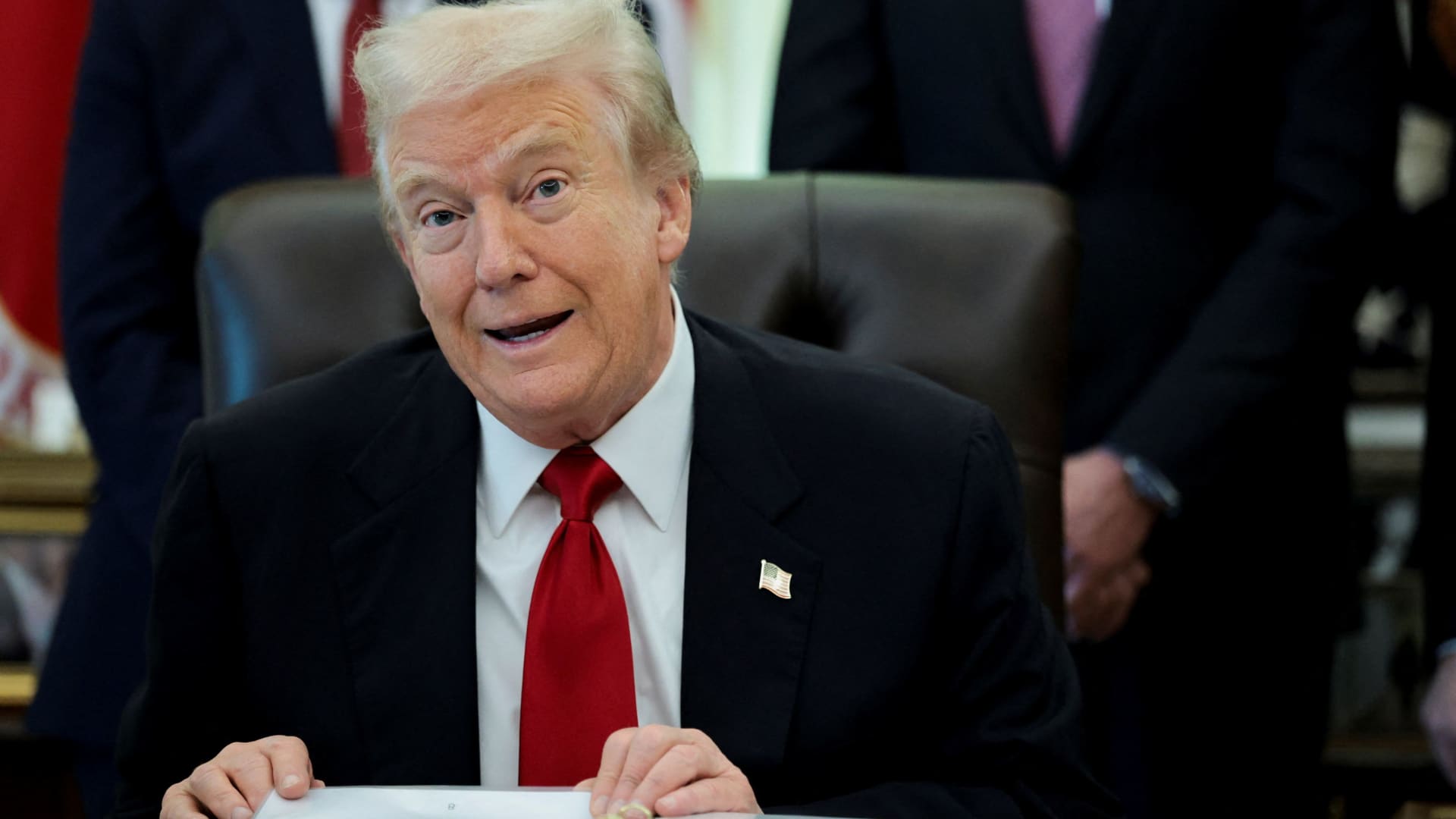
U.S. President Donald Trump makes an announcement from the Oval Office at the White House in Washington, D.C., U.S. Nov. 6, 2025.
Jonathan Ernst | Reuters
President Donald Trump on Thursday is slated to announce the launch of TrumpRx – a direct-to-consumer website that is key to his administration’s efforts to lower prescription drug costs in the U.S.
In a post on X, White House press secretary Karoline Leavitt said Trump and other administration officials will debut the new website at 7 p.m. ET on Thursday.
She said millions of Americans would save money through TrumpRx, but it’s still unclear if all patients – particularly those with insurance coverage – will see more cost savings from using that site to buy their medicines. TrumpRx targets people who are willing to pay with cash and forgo insurance, which suggests that people without or with limited coverage may benefit the most.
The site is not expected to sell drugs directly to American patients, but will act as a central hub that points them to drugmakers that are offering discounts on certain products on their own direct-to-consumer sites. For example, Eli Lilly and Novo Nordisk have offered their blockbuster obesity drugs at hefty discounts to cash-paying patients.
In recent months, both companies and at least 14 other drugmakers have negotiated agreements with the Trump administration to participate on the platform and voluntarily sell certain medicines at a discount to Medicaid patients. Those landmark deals are part of Trump’s broader “most favored nation” policy, which pushes to link U.S. drug prices to the lowest ones abroad.
It is the government’s latest effort to try to rein in U.S. prescription drug prices, which are two to three times higher on average than those in other developed nations – and up to 10 times more than in certain countries, according to the Rand Corp., a public policy think tank.
In an exclusive interview with CNBC last week, Eli Lilly CEO Dave Ricks said the company was the first drugmaker to sell obesity treatments directly to patients, and that TrumpRx is “taking that and expanding it across the industry” to other medicines.
“We’re all for that,” Ricks said.
Questions about savings
Questions remain about how much savings people can expect if they use TrumpRx to buy their medicines.
The announced price reductions for certain drugs are framed as steep cuts from their so-called retail list prices. For example, under Novo Nordisk’s agreement with the administration, its diabetes drug Ozempic will be priced at $350 per month on TrumpRx, which is less than half of its roughly $1,000 monthly list price.
But those list prices are often far higher than what private insurers and government programs ultimately pay for medicines after rebates, discounts and other concessions, according to researchers at Georgetown’s Medicare Policy Initiative. That suggests some payers may already be securing prices comparable to — or lower than — the newly announced discounts on medications under the Trump deals.
The researchers cited one study that found that average discounts on brand-name drugs in Medicare Part D run around 40% of list prices. Meanwhile, discounts in Medicaid exceed 75%, according to a Congressional Budget Office study.
Drugs on TrumpRx
The administration has not provided a full list of drugs that will be listed on TrumpRx.
But available information from recent drug pricing deals indicates many widely used drugs will be offered on the site at a discount:
Ozempic injection for diabetes, made by Novo Nordisk: $350 per month, down from around $1,000Wegovy injection for obesity, made by Novo Nordisk: $350 per month, down from around $1,350Wegovy pill for obesity, made by Novo Nordisk: $150 per month for the starting dosesZepbound injection for obesity, made by Eli Lilly: $350 per month, down from $1,086Trulicity for diabetes, made by Eli Lilly: $389 per month, down from about $1,000Emgality for migraines, made by Eli Lilly: $299, down from around $764Repatha for lowering cholesterol, made by Amgen: $239, down from $573Reyataz for HIV, made by Bristol Myers Squibb: $217, down from $1,449Januvia for diabetes, made by Merck: $100, down from $330Epclusa for Hepatitis C, made by Gilead: $2,425, down from $24,920Jentadueto for diabetes, made by Boehringer Ingelheim: $55, down from $525Xofluza for flu, made by Genentech: $50, down from $168 Advair Diskus inhaler 500/50, made by GSK: $89, down from $265Mayzent for multiple sclerosis, made by Novartis: $1,137, down from $9,987Plavix, made by Sanofi: $16, down from $756
In an interview with CNBC at a conference in January, Bristol Myers Squibb CEO Chris Boerner said the company has multiple products on its existing direct-to-consumer platform, which first offered a cash-pay discount on its blood thinner Eliquis. That platform will link to TrumpRx, he said.
The company is going to examine ways to put additional products in its portfolio on its own platform, “where it makes sense,” Boerner added. He said Bristol Myers is “aligned with the administration” on the issue of the U.S. healthcare system being too complex, and said several middlemen can increase costs.
“What we like about these [direct-to-consumer models], where they make sense from a business standpoint, is you’re able to circumvent some of that,” Boerner said.
